Holdover Chart — 5.56×45mm NATO, 50 to 300 m
Hold points every 50 m out to 300 m off a 100 m zero, with time of flight for each. Reduced to fit A4.
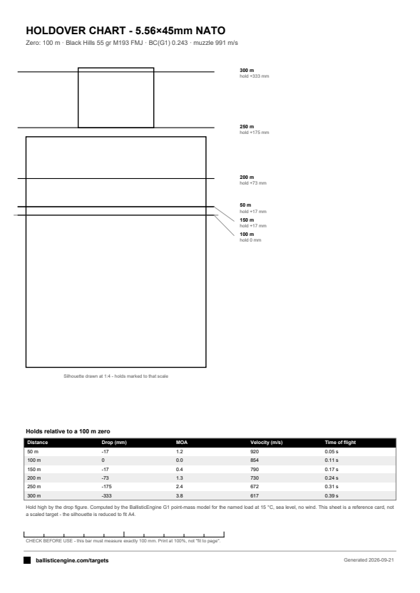
How to use it
- Print at 100%.
- Holds are relative to a 100 m zero with a 63 mm optic height.
- At 300 m the drop is 333 mm — a third of a metre, and more than a torso is tall at that range on paper.
- Time of flight matters on movers: 0.39 s at 300 m is a long time for the target to walk out of your hold.
Ballistic data on this sheet
| Distance | Drop (mm) | MOA | Velocity (m/s) | Time of flight |
|---|---|---|---|---|
| 50 m | -17 | 1.2 | 920 | 0.05 s |
| 100 m | 0 | 0.0 | 854 | 0.11 s |
| 150 m | -17 | 0.4 | 790 | 0.17 s |
| 200 m | -73 | 1.3 | 730 | 0.24 s |
| 250 m | -175 | 2.4 | 672 | 0.31 s |
| 300 m | -333 | 3.8 | 617 | 0.39 s |
Computed by the BallisticEngine G1 point-mass model at 15 °C, sea level, 1013 hPa, no wind. Negative drop means the bullet lands below the point of aim. A different bullet weight or barrel length moves every number in this table — run your own load.
Other targets
- Zeroing Target — 9×19mm @ 25 m
- Zeroing Target — 5.56 NATO @ 100 m
- Zeroing Target — .308 Win @ 100 m
- Diagnostic Target — group analysis
- Holdover Chart — 9mm, 7 to 50 m
- ISSF 10-Ring — Olympic air pistol
- NRA B-8 Repair Centre — 25 yd pistol
- IPSC / USPSA Classic
- IDPA Target
- FBI Q Silhouette
- Threat Silhouette — no zones
Customize for your setup. Barrel length, altitude and temperature all move the drop. The calculator takes any load in the database and recomputes this table for your conditions.