.308 Winchester Come-Up Chart — 100 to 800 m
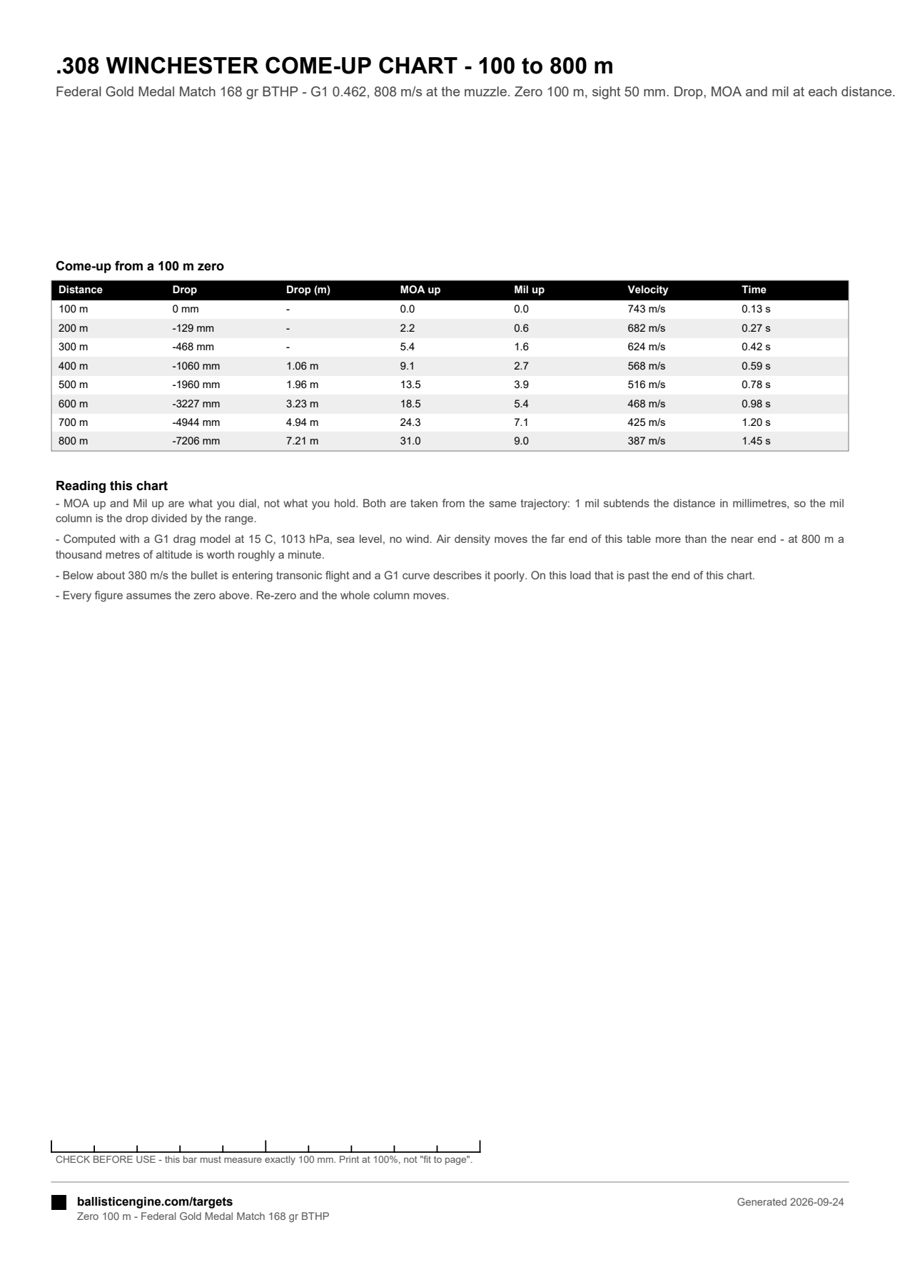
A dope card, not a holdover sheet. At 800 m this load is 7.2 m low — about nine silhouette heights — so there is no mark to put on a target. What you use at that range is a come-up, in MOA or mil, and that is what this prints.
How to use it
- Zero at 100 m first. Every figure on the card is measured from that zero, and a different one moves the whole column.
- Dial the MOA or mil for the range. Both columns come from the same trajectory — 1 mil subtends the distance in millimetres, so the mil figure is the drop divided by the range.
- Confirm on paper before trusting the far end. A G1 model describes a bullet poorly once it slows toward transonic, and the sheet marks where that starts.
- Altitude and temperature move the bottom of this card far more than the top — at 800 m a thousand metres of elevation is worth about a minute.
Dimensions on this sheet
| Distance | Drop | Drop (m) | MOA up | Mil up | Velocity | Time |
|---|---|---|---|---|---|---|
| 100 m | 0 mm | - | 0.0 | 0.0 | 743 m/s | 0.13 s |
| 200 m | -129 mm | - | 2.2 | 0.6 | 682 m/s | 0.27 s |
| 300 m | -468 mm | - | 5.4 | 1.6 | 624 m/s | 0.42 s |
| 400 m | -1060 mm | 1.06 m | 9.1 | 2.7 | 568 m/s | 0.59 s |
| 500 m | -1960 mm | 1.96 m | 13.5 | 3.9 | 516 m/s | 0.78 s |
| 600 m | -3227 mm | 3.23 m | 18.5 | 5.4 | 468 m/s | 0.98 s |
| 700 m | -4944 mm | 4.94 m | 24.3 | 7.1 | 425 m/s | 1.20 s |
| 800 m | -7206 mm | 7.21 m | 31.0 | 9.0 | 387 m/s | 1.45 s |
Other targets
- Zeroing Target — 9×19mm @ 25 m
- Zeroing Target — 5.56 NATO @ 100 m
- Zeroing Target — .308 Win @ 100 m
- Diagnostic Target — group analysis
- Holdover Chart — 9mm, 7 to 50 m
- Holdover Chart — 5.56 NATO, 50 to 300 m
- ISSF 10-Ring — Olympic air pistol
- NRA B-8 Repair Centre — 25 yd pistol
- IPSC / USPSA Classic
- IDPA Target
- FBI Q Silhouette
- Threat Silhouette — no zones
- ISSF 10 m Air Rifle — Olympic precision
- Vital Zone — White-Tailed Deer
- Vital Zone — Wild Boar
- Vital Zone — Elk
Customize for your setup. Barrel length, altitude and temperature all move the drop. The calculator takes any load in the database and recomputes this table for your conditions.