.45 ACP 25 Yard Zero Target
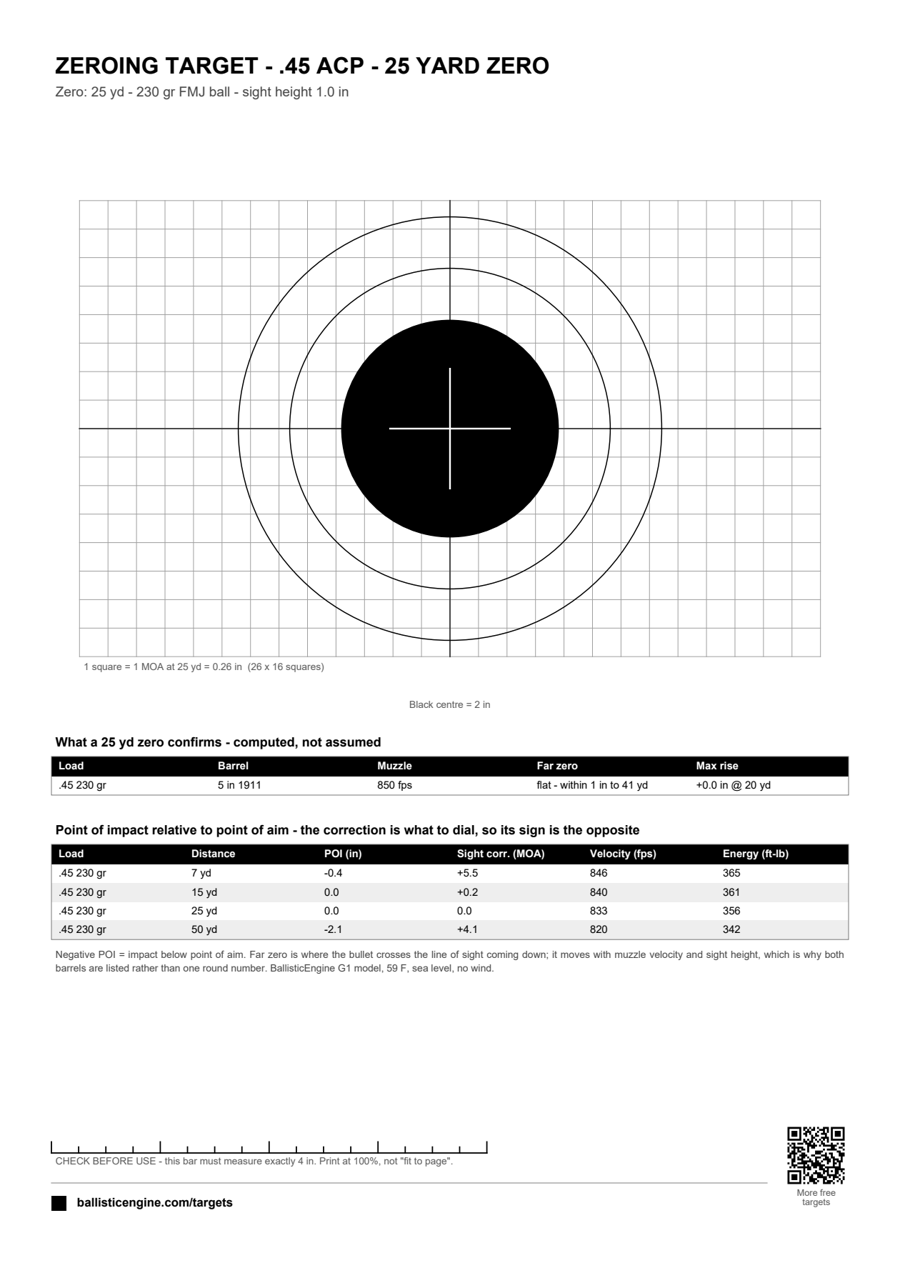
Twenty-five yards with 230 gr ball out of a five-inch 1911. The trajectory is flat enough that the bullet crosses the line of sight coming down at the zero itself, so the sheet reports how far the hold stays inside one inch instead of quoting a second zero that means nothing.
How to use it
- Print at 100% and check the 4 in bar.
- Set the target at 25 yd and fire five rounds from a rest.
- One grid square is one MOA at 25 yd, which is 0.26 in.
- A 230 gr load shot at 50 yd drops noticeably — the table gives the number before you find it on steel.
Ballistic data on this sheet
| Distance | Drop (mm) | MOA | Velocity (m/s) | Energy (J) | |
|---|---|---|---|---|---|
| .45 230 gr | 7 yd | -0.4 | +5.5 | 846 | 365 |
| .45 230 gr | 15 yd | 0.0 | +0.2 | 840 | 361 |
| .45 230 gr | 25 yd | 0.0 | 0.0 | 833 | 356 |
| .45 230 gr | 50 yd | -2.1 | +4.1 | 820 | 342 |
Computed by the BallisticEngine G1 point-mass model at 15 °C, sea level, 1013 hPa, no wind. Negative drop means the bullet lands below the point of aim. A different bullet weight or barrel length moves every number in this table — run your own load.
Other targets
- Zeroing Target — 9×19mm @ 25 m
- Zeroing Target — 5.56 NATO @ 100 m
- Zeroing Target — .308 Win @ 100 m
- Zeroing Target — 5.56 NATO @ 50 yd
- Zeroing Target — 5.56 NATO @ 36 yd
- Zeroing Target — 5.56 NATO @ 25 yd
- Zeroing Target — .308 Win @ 100 yd
- Zeroing Target — 9mm @ 25 yd
- Zeroing Target — 9mm @ 15 yd
- Diagnostic Target — group analysis
- Holdover Chart — 9mm, 7 to 50 m
- Holdover Chart — 5.56 NATO, 50 to 300 m
- ISSF 10-Ring — Olympic air pistol
- NRA B-8 Repair Centre — 25 yd pistol
- IPSC / USPSA Classic
- IDPA Target
- FBI Q Silhouette
- Threat Silhouette — no zones
- ISSF 10 m Air Rifle — Olympic precision
- .308 Come-Up Chart — 100 to 800 m
- Vital Zone — White-Tailed Deer
- Vital Zone — Wild Boar
- Vital Zone — Elk
- Vital Zone — Wild Turkey
- Vital Zone — Coyote
- Vital Zone — Moose
- Vital Zone — Pronghorn
- Vital Zone — Black Bear
Customize for your setup. Barrel length, altitude and temperature all move the drop. The calculator takes any load in the database and recomputes this table for your conditions.